
8 Questions to Ask Before Taking Any AI Opinion Seriously
How to separate serious critique from protective distance.


The resistance to AI rarely sounds irrational from the inside.
It usually comes with serious concerns around quality, craft, hallucinations, privacy, copyright, skill degradation, and the very reasonable concern that maybe outsourcing too much to AI will make us worse at thinking.
And I believe it’s understandable. Nobody wants to spend ten years getting good at writing, research, strategy, synthesis, customer understanding, and all the other respectable knowledge work things, only to watch a model produce an annoying first pass in forty minutes.
Also, the objections are very real at certain levels and under certain circumstances. A model can be generic, a setup can be fragile, and a fluent answer can quietly miss the point that someone close to the market would catch immediately. In a company, the question is never only whether the tool works. It is whether the surrounding system, data access, permissions, approval logic, ownership, and review can absorb what the tool produces without turning speed into new operational debt.
So no, I do not think every resistance to AI is fear.
But I do think some resistance is hiding behind better arguments than it deserves.
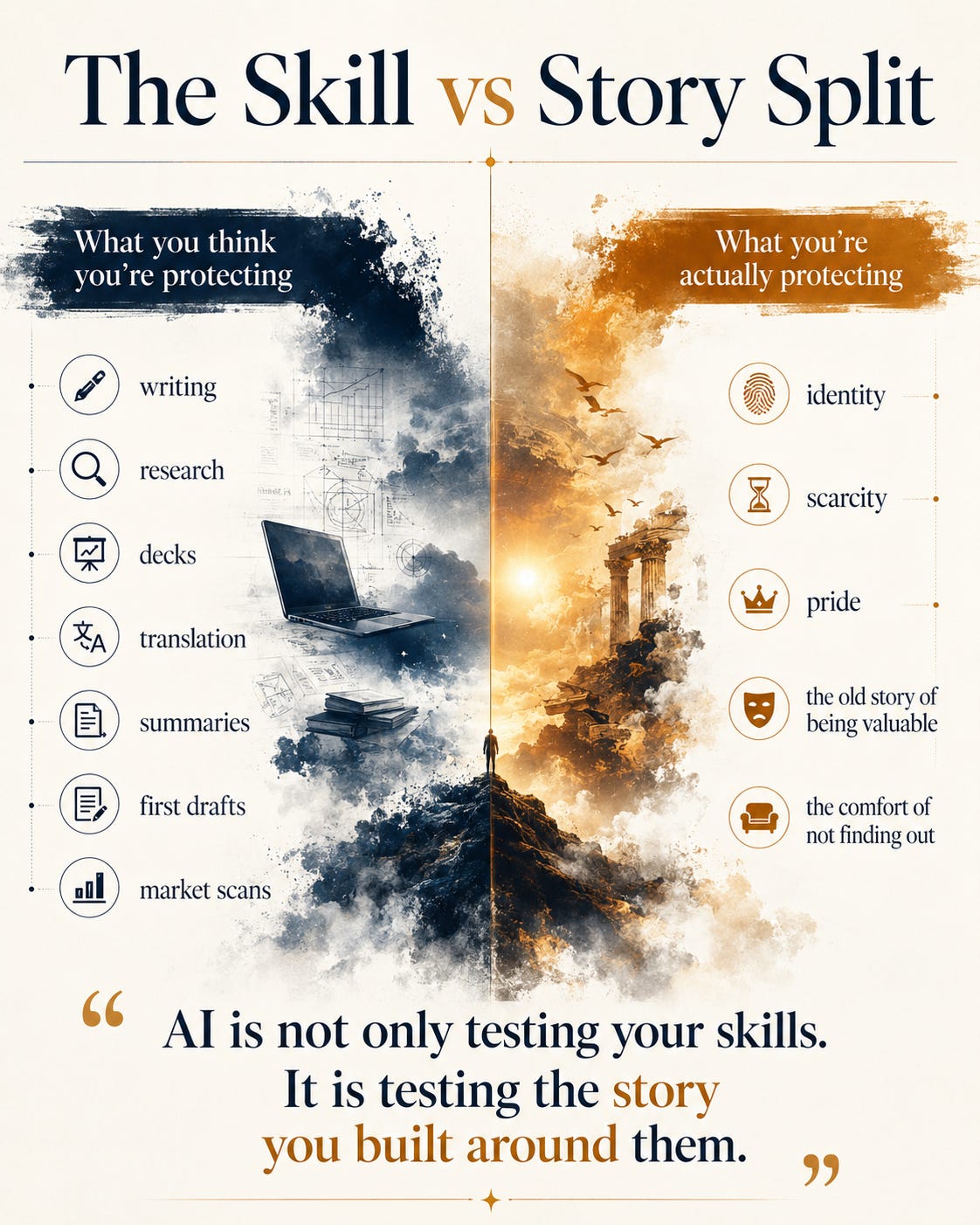
Because after a certain point, “I do not want to lose my skills” and “AI is not working” stop sounding like quality standards and start sounding like something else: the fear of discovering that some part of the work we built our professional identity around was less scarce than we thought.
For a long time, effort and judgment were almost impossible to separate. If you were good at writing, research, strategy, or synthesis, the visible artifact carried both: the hours spent making sense of the material and the taste required to decide what mattered. The output was not just the deliverable. It was evidence that you knew what you were doing.
AI disturbs that arrangement because it starts separating the layers.
It can produce the first version, clean the structure, summarize the source material, translate the format, and generate options.
Not always well. Not without context. But often well enough to make the old story less stable.
That is the part of the AI conversation that still feels underdeveloped to me.
We talk about productivity, hallucinations, governance, model choice, and occasionally about taste (usually after someone has published another thread about why AI writing has too many em dashes).
But the more uncomfortable layer is not technical. It is biographical.
It is the moment when a professional realizes that the task they used to treat as proof of expertise can now be split into pieces, and some of those pieces are not expertise anymore. They are structure, repetition, formatting, synthesis, first pass production. Useful work, but no longer rare work.
And at that point, you do not just need to learn a new tool. You also need to update the story you tell yourself about why you matter at work.
The part I did not enjoy discovering
That happened to me as well.
A few weeks ago, I had to produce a marketing deliverable that would normally take me most of a day. A newsletter for a few thousand subscribers with product updates, release news, webinar information, and useful context around the market, plus many rounds of edits and comments.
The kind of work that sounds simple if you describe it badly, and is not simple when you are the one trying to make it useful.
Everyone who has ever done it knows that the work is not just “writing a newsletter.” It is deciding what matters, what can be compressed, what the customer needs to know now, what should not sound like a feature dump, and how to connect product news to a person who is busy, technical, and not waiting for another marketing email to complete their day.
I used to feel slightly proud of that kind of work.
Not in a dramatic way. More in the quiet way you feel proud of something that proves you have accumulated judgment, the kind that turns product news into something a technical customer might actually find useful.
Then I built a very simple GPT project. It was not impressive in the way AI demos are supposed to be impressive. No agent chain, no elaborate automation architecture, no theatrical claim that the machine was now running marketing. It was mostly a structured environment with product context, examples, tone, workflow logic, and enough rules to move from raw updates to a usable first draft.
But even though the architecture was simple, the implementation was not.
I had been working for months on the knowledge files around it, slowly turning repeated corrections into context the system could reuse. The work was not glamorous, which is usually a good sign that it was closer to infrastructure than content. It was mostly removing ambiguity, making implicit standards visible, and teaching the system what good should look like in our specific environment.
Because when AI feels disappointing, the model is often not the real culprit. Usually, the missing layer is context, especially the kind that makes standards, constraints, and feedback visible to the system.
It is the same lesson I had learned last year while building a process to keep my own voice when editing with ChatGPT: the model does not magically preserve taste, context, or standards because you asked nicely. You have to encode them somewhere.
But after all that setup, the AI had done in 40 minutes the part I would usually spend hours building.
The structure was there. The main news items were there. The first pass was cleaner than my first pass often is. It also let me add a section I had wanted to include for a long time and never had enough time to build properly: regulatory changes and market trends that could make the newsletter more useful to customers, not just more complete for us.
I looked at it and had the specific kind of silence that happens when you are still trying to understand exactly what just happened.
The tool had not taken the work away from me. It had shown me that the work was not one thing. Some of it was judgment. Some of it was context. Some of it was production. Some of it was just me being good at doing the slow, manual part.
And, uncomfortable as it was to admit, it was not the part the company, or my future career, needed me to protect.
The grind was never the whole value
Experience does not disappear. It moves toward context, taste, judgment, and ownership. It shows up when the output is technically correct but commercially useless, when the real question was missing from the prompt, or when the right decision is not to automate something just because it can be automated.
Writing still matters, but less as filling the page from zero and more as knowing what the piece is allowed to say, what it should refuse to say, and why the reader should believe it.
Research still matters, but less as collecting everything manually and more as knowing which source changes the decision.
Marketing still matters, but less as producing another asset and more as understanding the customer, the sales reality, the product constraint, and the business consequence.
That is much less comforting than saying “AI cannot replace human creativity.” It is also more useful.
The skill is not preserved by refusing the tool. The skill is preserved by moving up the value chain of the task and becoming more explicit about the judgment that used to be hidden inside the effort.
If your value is that you understand what the artifact is for, what context it needs, what tradeoffs it carries, and what decision it should support, AI gives you a better place to stand.
But only if you use the time it gives back to build those skills.
The objection has to survive contact with the work
A bad test is easy to recognize. You open a weak model, give it a vague task, add no context, stop at the first mediocre answer, and compare the result to what a senior person would produce after years inside a market. The output is flat. You close the tab with relief.
Great. The previous story survives.
But that is not critique. That is distance management.
A serious critique starts later, when the tool has been tested enough to make the work uncomfortable. That means a real deliverable, a strong model, the context a competent junior would need, and enough iteration to see what improved, what stayed wrong, and what failed for reasons that actually matter.
A useful objection names the boundary. A model failure, a context failure, a governance constraint, and a workflow that creates more review work than it removes are not the same problem. Treating them as the same thing keeps the conversation morally satisfying and operationally useless.
That kind of critique is valuable because it gives the team an actual decision: redesign the system, constrain the use case, move the work to a different environment, or deliberately leave it alone.
So before treating any AI opinion, including your own, as fully formed, these are the questions I would ask.
Have you tested the tool on something you are actually good at, not only on work you already considered low value?
Have you used a strong enough model to judge the current capability, or are you still judging the category from an old, weak, or free version?
Did you give the system the context a competent junior would need?
Have you tried more than one round, or did the first mediocre answer become the whole verdict?
Do you know where the failure happened: model quality, missing context, weak instructions, bad examples, unclear success criteria, permissions, review, governance, or workflow design?
Have you learned the difference between the environments you are using, or are chat, projects, custom GPTs, Claude Code, Cowork, memory, project instructions, and knowledge files still blurred concepts?
If AI made one part of your work cheaper, have you identified which skill becomes more important because of that?
Can your objection help someone redesign the system, or does it only protect the old way of working?
The point of these questions is not to force optimism. A good answer may still be that this task should not be automated, that the data should not go there, or that a fluent draft is still very far from a finished thought. That is not anti-AI. That is a more serious standard for using it.
But at least the critique becomes specific enough to work with. And once the critique becomes specific, the skills conversation changes.
You stop asking whether AI will make you less valuable.
You start asking which parts of your value were hidden inside the grind, and which parts are still yours to build.